Beginner guideNever played before? Start here.Open
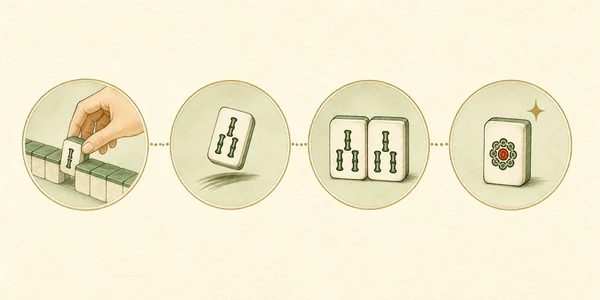
- 1Draw
- 2Discard
- 3Claim
- 4Win
The most common winning hand has four sets and one pair.
Know the tilesOpen
Start with the three numbered suits: Characters, Dots and Bamboo.
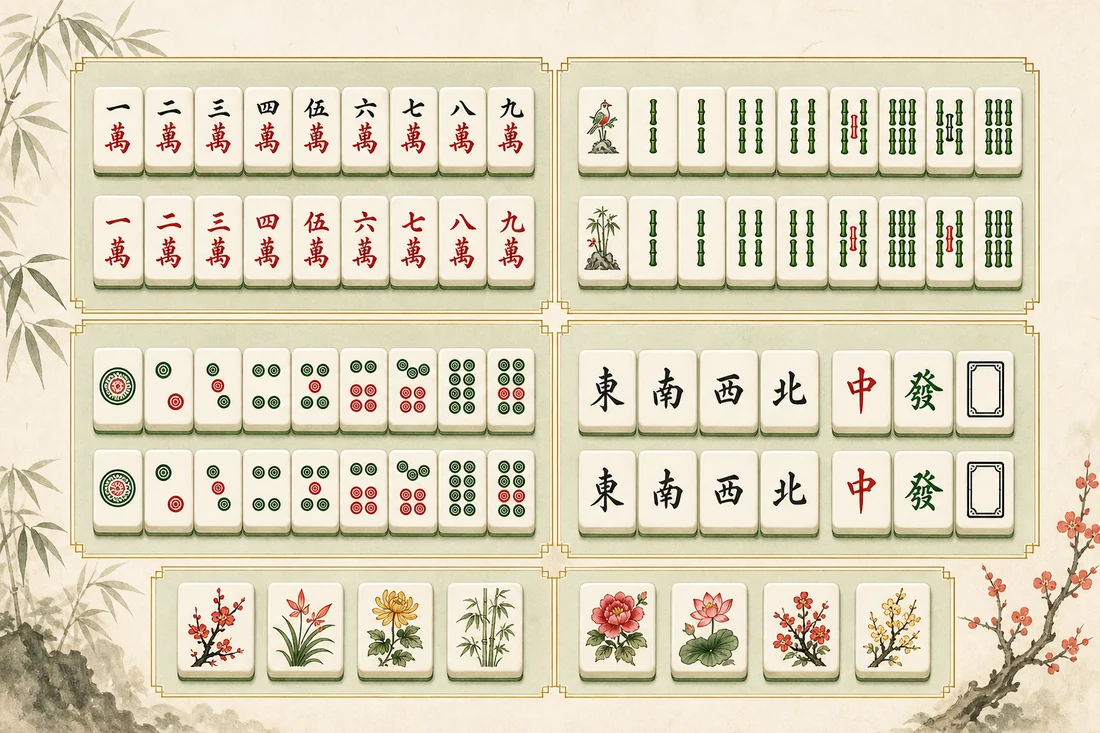
Most Chinese mahjong sets use three numbered suits: Characters, Dots and Bamboo. Each suit runs from one to nine, with four copies of every tile.
Some rule sets also use the four Winds and the three Dragons. Flower tiles are included only when the chosen rules require them.
Numbered tiles can form sequences. Winds and Dragons have no numbers, so they can only form pairs, triplets or quads.
Starting a handOpen
Mahjong is usually played by four people. After shuffling, the tiles are stacked into walls and each player receives thirteen tiles.
The dealer begins with fourteen tiles and discards first. Play then continues with one draw and one discard per turn.
Chow, Pung and KongOpen
Chow (吃): use the discard from the player immediately before you to make three consecutive tiles in one suit.
Pung (碰): if you already hold two identical tiles, claim the matching discard from any player and expose the triplet.
Kong (杠): four identical tiles form a quad. After declaring it, you normally draw a replacement tile before discarding.
Regional rules differ on exposed Kongs, concealed Kongs and robbing a Kong. Confirm these rules before play.
How to winOpen
The most common structure is four sets and one pair, using fourteen tiles in total.
A set may be a sequence, a triplet or a quad. The pair is two identical tiles.
Winning with the tile you draw yourself is a self-draw. Winning on another player's discard is a discard win.
Special hands such as Seven Pairs do not use the standard structure. Whether they are allowed and how they score depends on the rule set.
More beginner questionsOpen
Why you usually hold thirteen tiles
Thirteen while waiting, fourteen while deciding, then back to thirteen.
While waiting for your turn, you normally hold thirteen tiles. At the start of your turn you draw one, briefly giving you fourteen.
If those fourteen tiles complete a legal hand, you may declare a win. Otherwise, discard one tile and return to thirteen.
After a Chow or Pung you claim another player's discard instead of drawing, expose the set, then discard one tile.
A complete winning hand
Four sets + one pair = the most common winning structure.
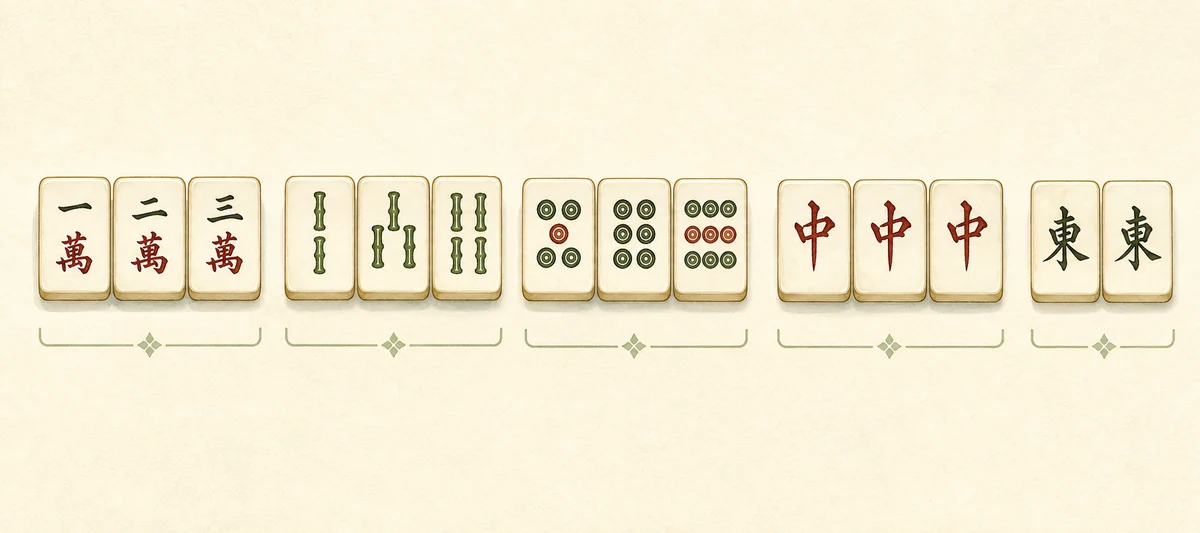
The example contains fourteen tiles: 1–2–3 Characters, 4–5–6 Bamboo and 7–8–9 Dots are three sequences; three Red Dragons form a triplet; two East Winds form the pair.
Three sequences plus one triplet make four sets. Adding the pair completes the standard winning structure.
A real game may also require a minimum score or another condition from the regional rules.
What is a ready hand?
A ready hand is not a win; it is one tile away.
A ready hand needs only one more tile to win. You may be waiting for one specific tile or several possible tiles.
For example, 2 and 3 Characters can wait for either 1 or 4 to complete a sequence. Two Red Dragons wait for the third Red Dragon to form a triplet.
Some rules require a declaration; others let you change your hand while waiting. Casual Chinese games usually require no formal announcement.
Dealer and the end of a hand
The dealer normally starts as East and discards first. Rules for keeping or passing the dealership vary.
A hand ends when someone wins or the wall runs out. Sichuan Bloody Battle continues after the first player wins.
Common beginner mistakes
Forgetting to discard after drawing: at the end of a normal turn you should hold thirteen tiles.
Forgetting to discard after a Chow or Pung: exposing the set does not end your turn; you still discard one tile.
Trying to make a sequence with Honour tiles: Winds and Dragons can only form pairs, triplets or quads.
Learn to complete the hand first. Add scoring patterns after the turn sequence feels natural.
How to teach the first game
The first game's goal is to finish a full hand, not to play perfectly.
Ignore scoring patterns in the first game and use only the four-sets-and-one-pair structure.
Allow Chow, Pung and Kong. A Chow uses only the previous player's discard; a Pung or win may use another player's discard.
End the hand as soon as someone wins and do not calculate complex bonuses.
Once everyone can draw, discard and claim without help, choose a regional rule set such as Sichuan or Hong Kong.
Sichuan MahjongFast play without Honour tiles. Players choose a missing suit, and Chows are normally not allowed.Open rules
Fast play without Honour tiles. Players choose a missing suit, and Chows are normally not allowed.
- Tiles
- Uses only Characters, Dots and Bamboo: 108 tiles in total. Winds, Dragons and Flowers are normally removed.
- Players
- Usually four. The dealer discards first, then play continues with one draw and one discard.
- Missing suit
- After the deal, each player chooses one suit to remove. A player normally cannot win while still holding tiles from that suit.
- Claims
- Pungs and Kongs are allowed; Chows normally are not. Continue with the required replacement draw or discard after a claim.
- Winning
- The basic structure is four sets and one pair. Seven Pairs, Full Flush and All Pungs depend on the agreed scoring table.
- Bloody Battle
- The first winner leaves the hand. The remaining players continue until three players have won or the wall is empty.
- Kongs and settlement
- Exposed, concealed and discard Kongs may be settled differently. Agree whether Kong payments happen immediately.
- Agree before play
- Confirm tile exchange, discard wins, multiple winners, the score cap, penalties for an uncleared suit and ready-hand checks.
Regional rules and house rules vary. Agree on the rules before the first hand.
Beijing MahjongBeijing rules vary widely, especially around wildcards, claiming tiles, closed hands and scoring.Open rules
Beijing rules vary widely, especially around wildcards, claiming tiles, closed hands and scoring.
- Tiles
- Commonly uses 136 tiles: the three numbered suits, Winds and Dragons, without Flowers.
- Players
- Usually four. The dealer discards first; the exact turn and dealer rules follow the table agreement.
- Wildcard
- Some versions reveal a tile to determine a wildcard; other versions use no wildcard at all.
- Claims
- Chow, Pung and Kong are commonly allowed. Some tables limit claims or require self-draw after an exposed set.
- Winning
- The base hand is four sets and one pair. Closed Hand, Seven Pairs, Pure Straight and Full Flush may add value.
- Priority
- A win normally has priority over Pung or Kong, which have priority over Chow. Agree how simultaneous winners are handled.
- Dealer
- Dealer multipliers, repeat dealership and draws vary significantly between tables.
- Agree before play
- Confirm wildcards, claim limits, discard-win conditions, scoring patterns, the cap and dealer rules. There is no single Beijing standard.
Regional rules and house rules vary. Agree on the rules before the first hand.
Wuhan MahjongCommon versions use Red Dragons and wildcards; exposed sets and the pair affect when and how a hand can win.Open rules
Common versions use Red Dragons and wildcards; exposed sets and the pair affect when and how a hand can win.
- Tiles
- Commonly uses 136 tiles: Characters, Dots, Bamboo and Honours, without Flowers.
- Wildcard
- A revealed tile determines the wildcard, which may stand for another tile. Its quantity and use as the pair depend on house rules.
- Red Dragons
- In common Red-Dragon Kong rules, Red Dragons must be declared as a Kong; keeping one in the hand may prevent a win.
- Opening the hand
- Chow, Pung and exposed Kong normally open the hand; concealed Kong and a Red-Dragon Kong often do not. Small wins may require an open hand.
- 2-5-8 pair
- A basic small win often requires a pair of 2s, 5s or 8s. Larger patterns may use another pair.
- Wildcard limit
- A small win commonly allows at most one wildcard in the hand. Two or more may require a recognised large hand.
- Open-hand scoring
- One version awards a single open-hand multiplier; another increases the multiplier for every exposed set. Do not mix the two.
- Agree before play
- Confirm how wildcards are chosen, the minimum score, Red-Dragon rules, hard wins, self-draw, discard wins and the cap.
Regional rules and house rules vary. Agree on the rules before the first hand.
Guangdong MahjongChicken Hand rules allow quick basic wins while still supporting high-value patterns.Open rules
Chicken Hand rules allow quick basic wins while still supporting high-value patterns.
- Tiles
- Commonly uses 136 tiles: the three suits, Winds and Dragons. Chicken Hand usually omits Flowers.
- Claims
- Chow from the previous player, Pung and Kong are allowed. Pung has priority over Chow; other Guangdong variants may ban Chows.
- Chicken Hand
- A legal four-sets-and-one-pair hand with no extra pattern is the basic win. Some tables allow it; others require a minimum fan.
- Common patterns
- All Sequences uses four sequences; All Pungs uses triplets or Kongs; Half Flush uses one suit plus Honours; Full Flush uses one suit only.
- Score cap
- Tables normally set a maximum fan. Special hands such as Thirteen Orphans or Big Three Dragons may exceed or automatically reach it.
- Special rules
- Common options include passed wins, multiple winners, robbing a Kong, liability after twelve exposed tiles, Kong draw and last-tile wins.
- Bonus draw
- Some versions reveal bonus tiles after a win and match them to seats for extra payment. Agree the number and matching method.
- Agree before play
- Confirm the exact Guangdong variant, Chows, minimum fan, cap, bonus draws, passed wins and liability.
Regional rules and house rules vary. Agree on the rules before the first hand.
Hong Kong MahjongA clear fan system; many tables require at least three fan before a hand may win.Open rules
A clear fan system; many tables require at least three fan before a hand may win.
- Tiles
- Usually 144 tiles: three suits, Honours and eight Flowers. Reveal a Flower and draw a replacement tile.
- Claims
- Chow from the previous player, Pung and Kong are allowed. Claimed sets stay exposed on the table.
- Three-fan minimum
- Many tables require at least three fan. A structurally complete hand with no scoring value cannot win. Beginner tables may use a one-fan minimum.
- Common fan
- Dragon, seat-wind or round-wind triplets, no Flowers, matching Flowers and self-draw may score. All Pungs, Half Flush and Full Flush score more.
- Flowers
- Seasons and plants correspond to seats. Matching Flowers, no Flowers and complete Flower sets vary by table.
- Limit
- A game sets a maximum such as eight, ten or thirteen fan. Listed limit hands are usually paid at that maximum.
- Settlement
- The discarder normally pays for a discard win; all three opponents pay a self-draw. Dealer, repeats and liability may change the amount.
- Agree before play
- Confirm the minimum fan, limit, Flower scoring, Chicken Hand, self-draw and discard wins, dealer rules and liability.
Regional rules and house rules vary. Agree on the rules before the first hand.
Changsha MahjongStarting-hand bonuses are common, while winning conditions emphasise a missing suit and special combinations.Open rules
Starting-hand bonuses are common, while winning conditions emphasise a missing suit and special combinations.
- Tiles
- Commonly uses the three suits and Honours. Some versions remove selected Honours, so check the table rules.
- Missing one suit
- A winning hand commonly has none of one numbered suit. Unlike Sichuan, the missing suit may not need to be declared at the start.
- Claims
- Pung and Kong are normally allowed. Rules for Chow and winning after a Chow differ between versions.
- Four of a kind
- Four identical tiles in the starting hand may earn an immediate bonus. Confirm whether they must be shown or kept for a concealed Kong.
- Two triplets
- Two triplets in the starting hand may earn a bonus, after which play continues.
- Banban Hu
- A starting hand without 2s, 5s or 8s may qualify as a special win or starting bonus in some versions.
- Winning
- The usual base remains four sets and one pair. All Pungs, Full Flush and Seven Pairs score separately; self-draw and discard rules vary.
- Agree before play
- Confirm Chows, the missing-suit condition, starting bonuses, Banban Hu, dealer multipliers and discard liability.
Regional rules and house rules vary. Agree on the rules before the first hand.
Hangzhou MahjongA wildcard-centred game that often rewards self-draw and consecutive multipliers.Open rules
A wildcard-centred game that often rewards self-draw and consecutive multipliers.
- Tiles
- Commonly uses 136 tiles: three suits and Honours, normally without Flowers.
- Caishen
- A White Dragon or revealed tile becomes the Caishen wildcard. Whether the revealed tile stays in the wall varies.
- Claims
- Chow, Pung and Kong are normally allowed. A concealed Kong may remain face down to opponents.
- Winning
- Many common versions mainly allow self-draw and no ordinary discard win. A long dealer run may unlock discard wins under house rules.
- Baotou
- A hand whose remaining structure is completed by one Caishen may wait to self-draw the final tile for a doubled Baotou win. Definitions vary.
- Caipiao
- A player in Baotou position discards the Caishen, then tries to self-draw on the next turn. This usually pays more than Baotou.
- Kong draw
- Winning immediately on the replacement tile after a Kong is a Kong draw. It may combine with Baotou or Caipiao for a higher multiplier.
- Agree before play
- Confirm the Caishen tile, whether it may form the pair, self-draw requirements, dealer rules, Baotou, Caipiao and liability.
Regional rules and house rules vary. Agree on the rules before the first hand.
Mahjong Competition RulesA unified competition system focused on recognising patterns accurately and combining scores correctly.Open rules
A unified competition system focused on recognising patterns accurately and combining scores correctly.
- Purpose
- This is a standard competition rule set rather than a regional home game. It suits groups that want one shared rules reference.
- Tiles
- Uses 144 tiles, including the three suits, Honours and eight Flowers. Each Flower scores 1 point but does not count toward the 8-point minimum.
- Claims
- Chow, Pung and Kong are allowed. A Chow uses only the previous player's discard; other claims follow priority rules.
- 8-point minimum
- After completing a legal hand, the scoring patterns must total at least 8 points before the player may declare a win.
- 81 patterns
- The system contains 81 patterns worth 1 to 88 points. High-value hands include Big Four Winds, Big Three Dragons, Nine Gates, Four Kongs and Thirteen Orphans.
- Scoring principles
- A hand may match several patterns, but non-duplication and highest-value principles prevent the same tiles from being counted repeatedly.
- Beginner focus
- Learn common 1-to-8-point patterns first, such as Self-draw, No Honours, One Voided Suit, Concealed Hand, All Pungs and Half Flush.
- Agree before play
- Official events follow the full rules. For a simplified home game, confirm the 8-point minimum, Flowers, timing and false-win penalties.
Regional rules and house rules vary. Agree on the rules before the first hand.
Booking confirmed
We look forward to seeing you at TIMI.
- Name
- Date
- Arrival
- Guests
- Type
- Estimated time
- Table
- Reference